
AI-Powered Chatbots – Transforming Customer Engagement and Business Efficiency
Introduction
The rapid evolution of artificial intelligence (AI) has fundamentally reshaped how businesses interact with their customers. Among the most impactful innovations is the rise of AI-powered chatbots – intelligent conversational agents capable of understanding and responding to human language in real time. These systems have moved far beyond scripted responses, leveraging advanced natural language processing (NLP) and machine learning techniques to deliver meaningful, context-aware interactions.
From customer support and marketing to healthcare and education, chatbots are becoming indispensable tools for organizations seeking to scale operations while maintaining high-quality user experiences.
What Are AI-Powered Chatbots?
AI-powered chatbots are software applications designed to simulate human conversation through text or voice interactions. Unlike traditional rule-based bots, modern chatbots use:
- Machine Learning (ML) to improve responses over time
- Natural Language Processing (NLP) to understand user intent
- Context awareness to maintain conversational flow
- Integration capabilities with CRM, ERP, and other enterprise systems
Popular platforms such as Dialogflow, IBM Watson Assistant and Microsoft Azure Bot Service enable businesses to build sophisticated conversational interfaces without deep expertise in AI.
Key Benefits of AI Chatbots
1. 24/7 Customer Support
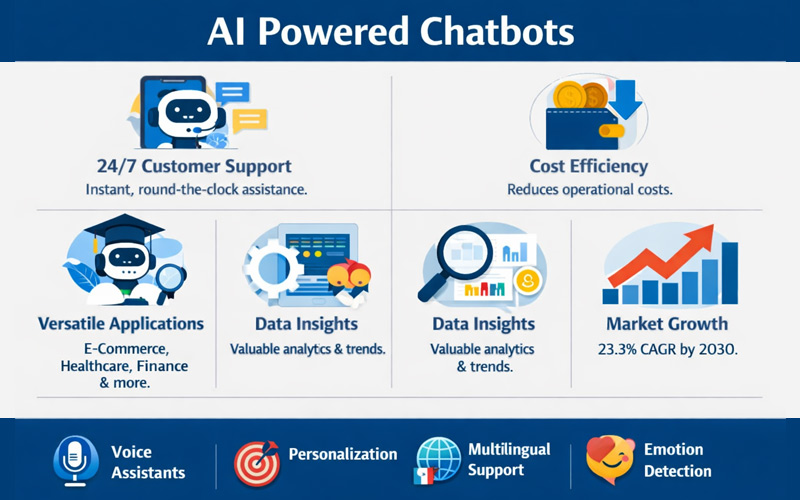
One of the most significant advantages of chatbots is their ability to provide round-the-clock support. Customers no longer need to wait for business hours to get answers, thus improving satisfaction and engagement.
2. Cost Efficiency
Chatbots reduce operational costs by automating repetitive tasks such as answering FAQs, processing orders, and handling basic troubleshooting. This allows human agents to focus on more complex issues.
3. Scalability
Unlike human teams, chatbots can handle thousands of simultaneous conversations without degradation in performance. This is particularly valuable during peak demand periods.
4. Personalization
Advanced chatbots analyze user behavior and preferences to deliver personalized responses, recommendations, and offers, enhancing customer experience and driving conversions.
5. Data Collection and Insights
Every interaction provides valuable data. Businesses can analyze chatbot conversations to identify trends, improve products and refine marketing strategies.
Use Cases Across Industries
E-Commerce
Chatbots assist customers with product discovery, order tracking and personalized recommendations. Platforms like WhatsApp Business and Facebook Messenger are widely used for conversational commerce.
Healthcare
AI chatbots help with symptom checking, appointment scheduling and patient engagement. While not a replacement for medical professionals, they improve accessibility and efficiency.
Banking and Finance
Banks deploy chatbots for balance inquiries, transaction alerts and fraud detection support. These systems enhance security while reducing customer service workload.
Education
Educational institutions use chatbots to assist students with admissions, course information, and learning support, making information more accessible.
The Role of NLP and Generative AI
The integration of advanced NLP models—such as those developed by OpenAI, has significantly enhanced chatbot capabilities. Modern systems can
- Understand nuanced language and context
- Generate human-like responses
- Handle multi-turn conversations
- Adapt tone and style based on user interaction
Generative AI has enabled chatbots to move beyond predefined scripts, offering dynamic and intelligent responses that closely mimic human communication.
Challenges and Considerations
Despite their advantages, AI chatbots come with certain challenges:
1. Accuracy and Hallucination
AI-generated responses may occasionally be incorrect or misleading. Ensuring accuracy through validation mechanisms is critical.
2. Data Privacy and Security
Handling user data responsibly is essential, especially in industries like healthcare and finance.
3. Integration Complexity
Integrating chatbots with existing enterprise systems can require significant technical effort.
4. User Trust
Some users may prefer human interaction, particularly for complex or sensitive issues. A hybrid approach—combining chatbots with human agents—is often the most effective.
Market Trends and Future Outlook
The global chatbot market is experiencing rapid growth. According to Grand View Research, the market is projected to grow at a compound annual growth rate (CAGR) of 23.3% from 2025 to 2030, driven by increasing adoption of AI and machine learning technologies.
Emerging trends include
- Voice-enabled chatbots integrated with smart assistants
- Multilingual conversational AI for global audiences
- Emotion-aware AI capable of detecting user sentiment
- Deep integration with business workflows
As AI continues to evolve, chatbots will become more autonomous, proactive and capable of handling complex decision-making tasks.
Best Practices for Implementing Chatbots
To maximize the effectiveness of AI chatbots, organizations should
- Define clear objectives – Identify specific use cases and outcomes
- Start simple – Begin with FAQ automation before expanding capabilities
- Ensure seamless handoff – Allow easy transition to human agents
- Continuously train the model – Improve accuracy using real interaction data
- Focus on user experience – Keep conversations natural and intuitive
Conclusion
AI-powered chatbots are no longer a futuristic concept, they are a present-day necessity for businesses aiming to stay competitive in a digital-first world. By enhancing customer engagement, reducing operational costs and providing valuable insights, chatbots are transforming how organizations interact with their audiences.
As advancements in AI and NLP continue to accelerate, the capabilities of chatbots will expand even further, making them an integral part of business strategy across industries. Organizations that adopt and optimize these technologies today will be better positioned to lead in the increasingly conversational digital landscape.
References
- Grand View Research. (2024). Chatbot Market Size, Share & Trends Analysis Report (2025–2030).
- IBM. (2023). What are chatbots?
- Microsoft. (2024). Azure Bot Service Documentation.
- Google. (2024). Dialogflow Documentation.
- OpenAI. (2024). Advances in Natural Language Processing and Generative AI.
- McKinsey & Company. (2023). The State of AI in Customer Service.