
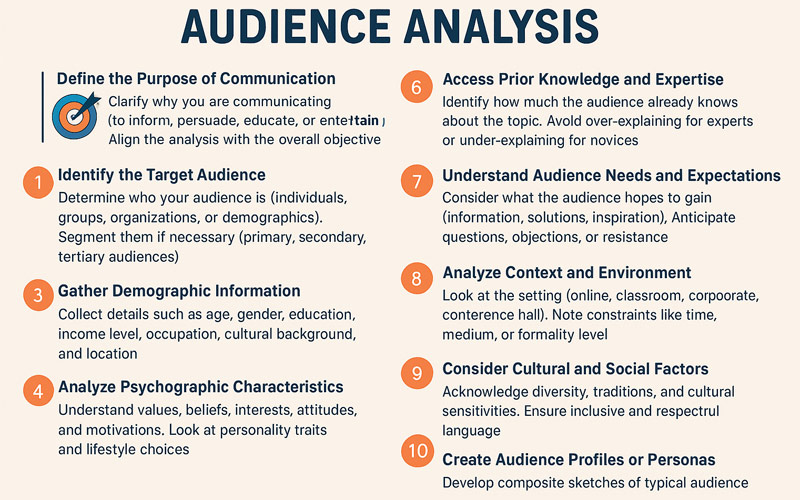
Audience Analysis – Understanding Your Audience for Effective Communication
In today’s fast-paced, information-heavy world, the effectiveness of communication depends not only on the content of the message but also on how well it resonates with the intended audience. This is where audience analysis becomes essential. By carefully studying the audience, communicators can ensure that their message is relevant, engaging, and impactful. Below, we explore the key steps of audience analysis in detail, each of which contributes to creating stronger connections and more persuasive communication.
Define the Purpose of Communication
Every successful communication effort begins with a clear understanding of purpose. Are you aiming to inform, persuade, educate, or entertain your audience? Defining this goal upfront shapes the way you design and deliver your message. Without clarity, communication risks becoming unfocused. A well-defined purpose ensures that your audience receives not just information, but value tailored to their expectations.
Identify the Target Audience
Once the purpose is established, the next step is identifying who exactly you are communicating with. This involves segmenting your audience into primary, secondary, and tertiary groups. For example, a company launching a new product may target customers as the primary audience, media professionals as the secondary audience, and internal stakeholders as tertiary. Knowing your audience ensures your message speaks directly to them.
Gather Demographic Information
Demographics form the foundation of audience profiling. By collecting data such as age, gender, education, income, occupation, and cultural background, communicators gain insights into audience perspectives. These factors influence not only how people receive information but also how they interpret it. A message that resonates with young professionals may not connect in the same way with retirees — demographics help avoid these mismatches.
Analyze Psychographic Characteristics
While demographics tell you who your audience is, psychographics reveal why they behave the way they do. This includes values, beliefs, attitudes, motivations, and interests. Psychographic analysis uncovers emotional and psychological drivers that shape decision-making. Two people with the same demographic profile may differ greatly in worldview. Understanding these differences allows you to craft messages that resonate at a deeper, personal level.
Assess Prior Knowledge and Expertise
To communicate effectively, you must know how much your audience already understands about your topic. Over-explaining risks losing experts, while under-explaining confuses novices. By assessing prior knowledge, you can strike the right balance between simplicity and depth. This creates an inclusive environment where both beginners and experienced individuals feel engaged and respected.
Understand Audience Needs and Expectations
Every audience comes with expectations and needs. Some may seek practical solutions, others inspiration, and still others reliable information. By identifying these expectations, you can position your message as the answer to their needs. Anticipating questions, objections, or resistance also builds credibility and strengthens trust with your audience.
Analyze Context and Environment
The setting of communication plays a major role in effectiveness. A motivational speech in a packed conference hall feels different from an online training webinar. Factors such as medium (in-person, digital, print), time constraints, and formality must be considered. Analyzing the context helps tailor delivery style so the message fits seamlessly into the audience’s environment.
Evaluate Communication Preferences
Audiences have preferred ways of receiving information. Some prefer detailed written reports, while others respond better to visuals, videos, or interactive discussions. Tone matters too — whether formal, conversational, or humorous. By matching your communication style to preferences, you improve engagement and ensure your message is received in the most effective format.
Consider Cultural and Social Factors
In a globalized world, diversity is the norm. Cultural traditions, social norms, and sensitivities influence how messages are perceived. A phrase that seems ordinary in one culture may be offensive in another. Recognizing these differences ensures inclusive, respectful communication. When diversity is respected, your message gains authenticity and broader acceptance.
Create Audience Profiles or Personas
To make insights actionable, communicators often build audience personas, fictional but research-based profiles of typical audience members. A persona might include demographics, psychographics, goals, and communication preferences. Personas serve as a guide, reminding you of “who you’re talking to” and helping craft communication that feels personal and relatable.
Adapt Message and Delivery
The final step is putting analysis into action. This means adjusting tone, vocabulary, examples, and delivery format to suit your audience. A technical audience may appreciate in-depth charts, while a general audience might need simplified analogies. When done effectively, adaptation makes communication feel relevant, personalized, and impactful.
Conclusion
Audience analysis is not just preparation, it’s the foundation of meaningful communication. By defining your purpose, understanding who your audience is, analyzing their characteristics, and adapting your delivery, you can craft messages that resonate and inspire action. Whether in marketing, teaching, leadership, or public speaking, mastering audience analysis ensures your communication is powerful, persuasive, and lasting.